Cambodia visa approval stamp
Practical Guide · 2026

Cambodia visa for expats and long-stay visitors:
the 2026 guide.

Tourist visa or E-class ordinary visa? EB, ER, or ES extension? FPCS registration? Tourist visa or E-class ordinary visa — the choice most people get wrong. Lord Penh explains Cambodia's visa system for people who are actually staying.


The Basics

Tourist visa vs ordinary visa: which Cambodia visa do you need?

Cambodia's system rests on two main entry paths. Most problems start when people choose the wrong one.
✈️
Short Stays · Tourism

Tourist Visa (T-class)

The standard option for anyone visiting Cambodia for a holiday or short trip. Valid for 30 days from entry, extendable once for another 30 days. Maximum stay on this route: around 60 days.

Available as an e-visa (applied online before travel, approval sent by email) or on arrival at major entry points. Under Cambodia's digital entry system, visa on arrival no longer always means a sticker in your passport — the record may be entirely electronic. That is not an error.

📅 30 days on entry, one 30-day extension possible
🌐 Apply online: evisa.gov.kh →
⚠️ Single entry. Not the right choice if you plan to stay longer than two months.

Passport validity: Your passport must be valid for at least six months on the date of entry into Cambodia. This is a hard requirement, not a guideline.


Then & Now

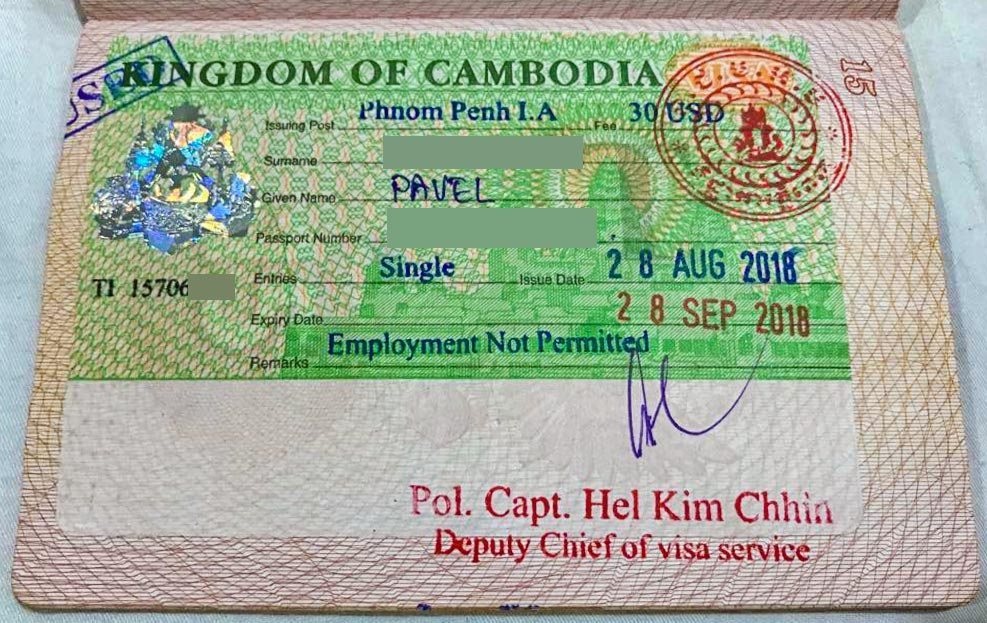
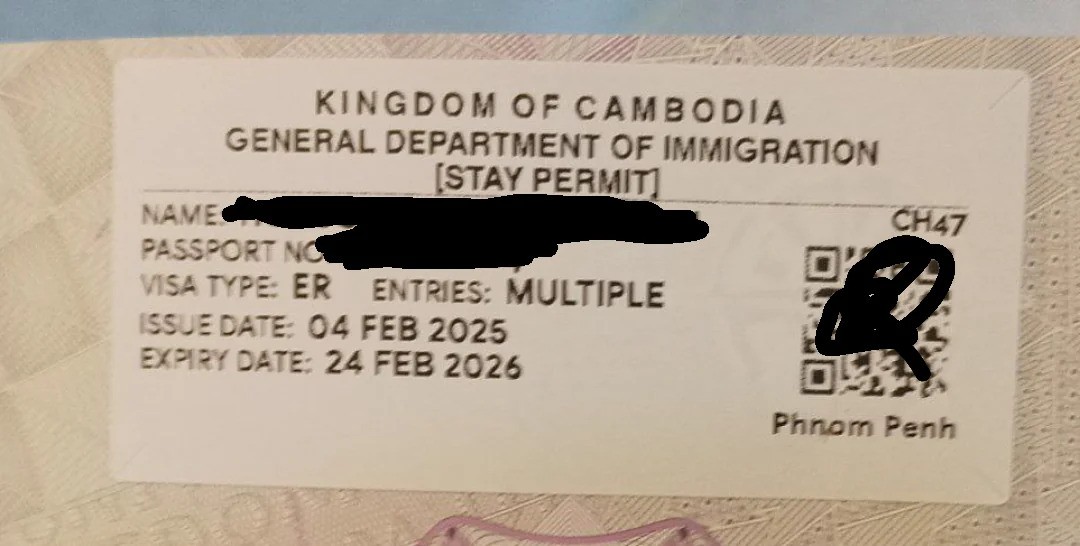
What a Cambodia visa looks like: then and now.

The format has changed significantly. Under the newer digital entry system, you may not get a sticker at all — the record exists electronically. Both remain valid forms of entry.
Old full-page Cambodia visa sticker in passport
The old full-page stickerA large, decorative visa taking up an entire passport page. Standard issue until Cambodia moved to a more compact format.
Current Cambodia visa sticker in passport
The current stickerA smaller adhesive label. Still issued at some border crossings — but increasingly, entry is processed electronically with no sticker at all.
Ordinary Visa Extensions

Cambodia ordinary visa extensions: EB, EG, ER, and ES explained.

Each covers a different type of stay. Know which one applies to you before you walk into a visa office.
EB

Business

For foreigners working in Cambodia, running a business, or operating as a freelancer with supporting documentation. The most common long-stay extension.

⏱ 3, 6, or 12 months
EG

Job-Seeker

For those actively looking for employment in Cambodia. Shorter duration than EB, intended as a bridge while arranging work.

⏱ Typically 3 months
ER

Retirement

For retirees aged 55 or older who are not employed in Cambodia. Applied for inside the country after entering on an E-class visa. Renewable indefinitely. See the full section below.

⏱ 1, 3, 6, or 12 months
ES

Student

For those enrolled in a recognized educational institution in Cambodia. Requires proof of enrollment from the institution.

⏱ Duration of study

On freelancers and digital nomads: Cambodia has no dedicated digital nomad visa, despite what older blog posts suggest. Freelancers may technically fall under the EB category, but longer renewals increasingly require documented proof of business activity or employment. The system has tightened. Approach this route with paperwork, not optimism.


Retiring in Cambodia

The Cambodia retirement visa (ER extension) explained.

The ER is not a separate visa — it is an extension of the E-class ordinary visa, applied for inside Cambodia. It is one of the more straightforward retirement options in Southeast Asia, and it can be renewed indefinitely.
ER · Extension of Stay · Age 55+

How the ER retirement extension works

You cannot apply for a retirement visa from outside Cambodia. The process is always two steps: enter on an E-class ordinary visa (not a tourist visa), then apply for the ER extension from inside the country — either directly at the Department of Immigration opposite Phnom Penh International Airport, or through a local visa agent.

Most expats use an agent. Going directly to Immigration means strict documentation requirements: notarised pension proof, official translations, the full paperwork stack. Agents have established processing channels where, in many cases, a valid passport, a few photos, and the fee are sufficient — the financial documentation requirements are significantly relaxed.

Requirements

  • 👤 Age 55 or older (exceptions for documented early retirement are rare)
  • 💼 Not legally employed in Cambodia — ER does not come with a work permit. If you plan to work or run a business, you need EB, not ER.
  • 💵 Proof of financial means: pension statement, Social Security letter, or bank statements showing roughly $1,000–1,500/month. Requirements are often relaxed via an agent.
  • 🛂 Passport valid for at least 6 months with blank pages available
  • 🏠 Active FPCS registration at your Cambodia address — mandatory for renewal

Durations & approximate agent costs

Duration Entry Est. cost
1 or 3 months Single-entry. Visa cancelled if you leave Cambodia. $50–90
6 months Multiple-entry. Leave and re-enter freely. ~$160
12 months Multiple-entry. Renewable indefinitely — no requirement to leave Cambodia to refresh it. ~$290

What you can do with a 12-month ER visa: open local bank accounts, sign long-term residential leases, and register a vehicle in your own name. You can legally purchase condominiums and apartments under Strata Title law (from the first floor up). You cannot own land — that restriction applies to all foreigners regardless of visa type.

Health insurance: Cambodia does not legally require health insurance for the ER visa, but serious medical care in Cambodia is limited. Most retirees carry private expat insurance covering medical evacuation to Bangkok or Singapore. Budget for it.

Cambodia My Second Home · CM2H

The Golden Visa: residency, rights, and a path to a Cambodian passport.

The CM2H program is Cambodia's formal investment residency scheme, launched by the Ministry of Interior to compete with Thailand's Elite Visa and Malaysia's MM2H. It is the only pathway in the region that leads directly to a second passport — without giving up your existing one.

10-Year Renewable Residency · Dual Citizenship Eligible · No Minimum Stay

What the CM2H gives you

A 10-year, multiple-entry golden visa sticker in your passport. You are not required to actually live in Cambodia to maintain it — the CM2H can be held purely as a backup residency or as insurance diversification. After five years, you become legally eligible to apply for Cambodian citizenship. Cambodia permits dual nationality, so your existing passport is unaffected.

🪪 10-year renewable residency, multiple-entry
🌍 Dual citizenship eligible after 5 years — no renunciation required
🏠 No minimum stay requirement to maintain the visa
🏦 Fast-tracked bank account setup (ABA Bank and others)
💵 No foreign exchange controls — hold and invest natively in USD
🚗 Local driver's license and full business rights

How to qualify: two investment paths

The CM2H is a formal investment immigration program, not a standard visa extension. You must fulfil one of two paths.

Path A — Real estate route (most common)

  • 🏢 Minimum $100,000 investment in a government-approved real estate project — primarily condominium developments in Phnom Penh or Sihanoukville
  • 📋 You receive a hard title deed (foreigners can legally own condominiums from the first floor up)
  • 💰 Additional processing and membership fees via the Khmer Home Charity Association — typically around $50,000 all-in, covering legal work, background checks, and filing
  • 🛂 Path to citizenship after 5 years of holding the visa

Path B — Direct citizenship by investment (fast track)

  • 🎁 Non-refundable donation of approximately $250,000 to the Royal Government budget, or
  • 📈 Direct investment of approximately $312,000 into approved national development funds
  • 📚 Requires passing a basic Khmer history and language test
  • ✈️ Requires travelling to Cambodia for an oath-taking ceremony
  • Bypasses the 5-year wait entirely — citizenship granted directly

The application process: roughly 3 to 6 months

All applications are handled under the supervision of the General Department of Immigration through officially sanctioned legal firms.

1
Month 1

Due diligence & pre-approval

Submit background documents to the Ministry of Interior: valid passport, clean criminal record from your home country, and proof of legitimate source of funds.

2
Month 2

Select and secure the investment

Once pre-approved, choose an eligible project. Sign the Sale and Purchase Agreement for the property and transfer the investment and processing fees.

3
Month 3

Application submission

Authorised legal agents submit official documents and property titles to the Ministry of Interior to generate your CM2H member profile.

4
Month 4

Visa issuance

On final approval, travel to Cambodia if outside the country. The General Department of Immigration prints and stamps the 10-year golden visa into your passport.

Use only authorised agents. Because the CM2H involves significant capital, the Cambodian government only permits applications through officially sanctioned legal firms and the Khmer Home Charity Association. The casual street-side agents who handle tourist visa renewals have no role here. If someone at a bike-rental shop offers to arrange a Golden Visa, walk away.


FPCS registration: the Cambodia visa requirement nobody warns you about.

The Foreigners Presence in Cambodia System tracks where foreign nationals are staying in the country. It applies to tourists and long-term residents alike.

Hotels handle FPCS registration automatically when you check in — which is one reason short stays in hotels rarely produce bureaucratic surprises. Private rentals, serviced apartments, Airbnb-style arrangements, and informal guesthouses are far less consistent. If you are renting privately in Phnom Penh or anywhere else in Cambodia, it is worth confirming explicitly that your landlord has actually registered your presence.

This is not a bureaucratic nicety. Failure to be registered in FPCS can prevent you from extending your visa. It is the kind of small, easily overlooked detail that becomes a significant problem at exactly the wrong moment — usually when you are already at a visa office with a deadline approaching.

If you move accommodation, the registration needs to follow. It does not transfer automatically.

In short: Confirm your accommodation is registered. Do it at the beginning of your stay, not when you are trying to extend your visa.


Common Mistakes

Three Cambodia visa mistakes that are easy to avoid.

None of these are exotic errors. They happen regularly.

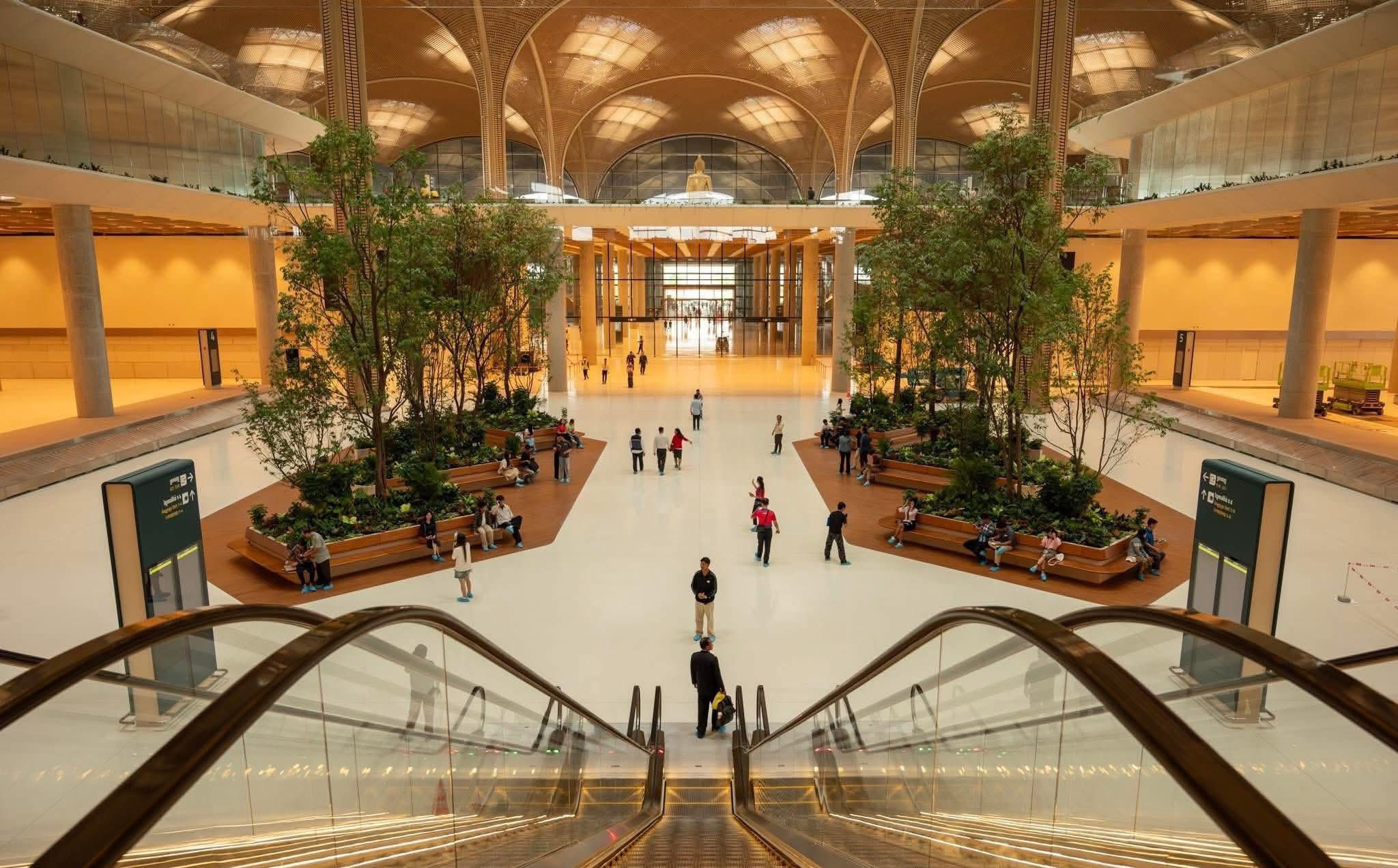
Arrivals hall at Techo International Airport, Phnom Penh
Techo International Airport, Phnom Penh.
The paperwork starts here. Get it right.
The Short Version

Tourist visa (T-class): 30 days, one extension, maximum around 60 days. Good for holidays and short visits. Apply via evisa.gov.kh or on arrival.

Ordinary visa (E-class): The foundation of every long-term stay. Request it on arrival. Extendable into four categories: EB (work/business), ER (retirement), ES (student), EG (job-seeker).

Retirement visa (ER extension): Age 55+, not employed in Cambodia, applied for inside the country after entering on an E-class. The 12-month multiple-entry version is renewable indefinitely. Most expats process it through a local agent.

FPCS registration: Make sure your accommodation has registered you. This is a hard requirement for any visa extension. Do not assume it has happened.

Visa agents: Cambodia has capable agents who handle extensions on your behalf. Use one with a track record, keep your own copies of everything, and do not rely on verbal assurances about what is and is not possible.


Frequently Asked Questions

Cambodia visa questions, answered.

What is the difference between a Cambodia tourist visa and an ordinary visa?

The tourist visa (T-class) is valid for 30 days on entry and can be extended once for another 30 days — giving a maximum stay of around 60 days. The ordinary visa (E-class) is designed for longer stays and can be extended for 3, 6, or 12 months under four categories: EB for work or business, ER for retirement, ES for students, and EG for those seeking employment.

Can I convert a Cambodia tourist visa to an E-class ordinary visa after arrival?

This is not the standard or official pathway. Some agents in Phnom Penh claim it can be arranged, but it is not a reliable route and frequently results in wasted time and money. If you plan to stay longer than two months, request the E-class ordinary visa at the border — not the tourist visa.

What is FPCS registration in Cambodia and why does it matter for visa extensions?

FPCS — the Foreigners Presence in Cambodia System — is the government database that records where foreign nationals are staying. Hotels register guests automatically at check-in. Private rentals and informal accommodation often do not. If your accommodation has not registered your presence, you may be unable to extend your visa even if all your other documents are in order. Confirm it at the start of your stay, not when you are already at the immigration office.

Is there a digital nomad visa for Cambodia in 2026?

No. Cambodia does not offer a dedicated digital nomad visa. Freelancers can apply for an EB extension under the E-class ordinary visa, but renewals increasingly require documented proof of business activity or employment. The process has tightened considerably compared to what older expat guides suggest.

Does Cambodia still stamp passports on arrival in 2026?

Not always. Under Cambodia's newer digital entry system, visa on arrival may be processed electronically without a sticker in your passport. A digital record or email confirmation serves as proof of entry. The absence of a physical stamp does not mean something has gone wrong — provided the visa was properly processed and the electronic record exists.

What is the Cambodia Golden Visa (CM2H) and who is it for?

The Cambodia My Second Home (CM2H) program is the country's formal investment residency scheme. It offers a 10-year renewable multiple-entry visa, no minimum stay requirement, and a legal pathway to Cambodian dual citizenship after five years — without surrendering your existing passport. The main route requires a minimum $100,000 investment in approved real estate plus around $50,000 in processing fees. A direct citizenship-by-investment route is also available from approximately $250,000. This is for investors and high-net-worth individuals; it is not a standard expat or retirement visa.

How do I get a retirement visa for Cambodia, and can I apply from outside the country?

You cannot apply for a Cambodia retirement visa from abroad. You must first enter Cambodia on an E-class ordinary visa, then apply for the ER (retirement) extension from inside the country — either directly at the Department of Immigration in Phnom Penh, or through a local visa agent. You must be 55 or older and not employed in Cambodia. The 12-month ER extension is multiple-entry and can be renewed indefinitely without leaving the country.